
[fsn_row][fsn_column width=”12″][fsn_text]
Examining capital, labour, disruption, maintenance and lifecycle across competing solutions
Retailers continuously evaluate strategies to improve fresh-food display performance while balancing operational costs, energy efficiency, and product quality. Open refrigerated cases are essential for shopper access, but they present challenges in maintaining cold-chain integrity and minimizing energy use. Options for improving overnight temperature retention include Econofrost night covers, full case replacement, and retrofitting with glass doors.
Understanding the total cost of ownership (TCO) for each solution including capital investment, labour, installation disruption, maintenance, and lifecycle helps store operators make informed decisions that optimize both operational efficiency and product quality.
Econofrost Night Covers: A Low-Capital, High-Impact Solution
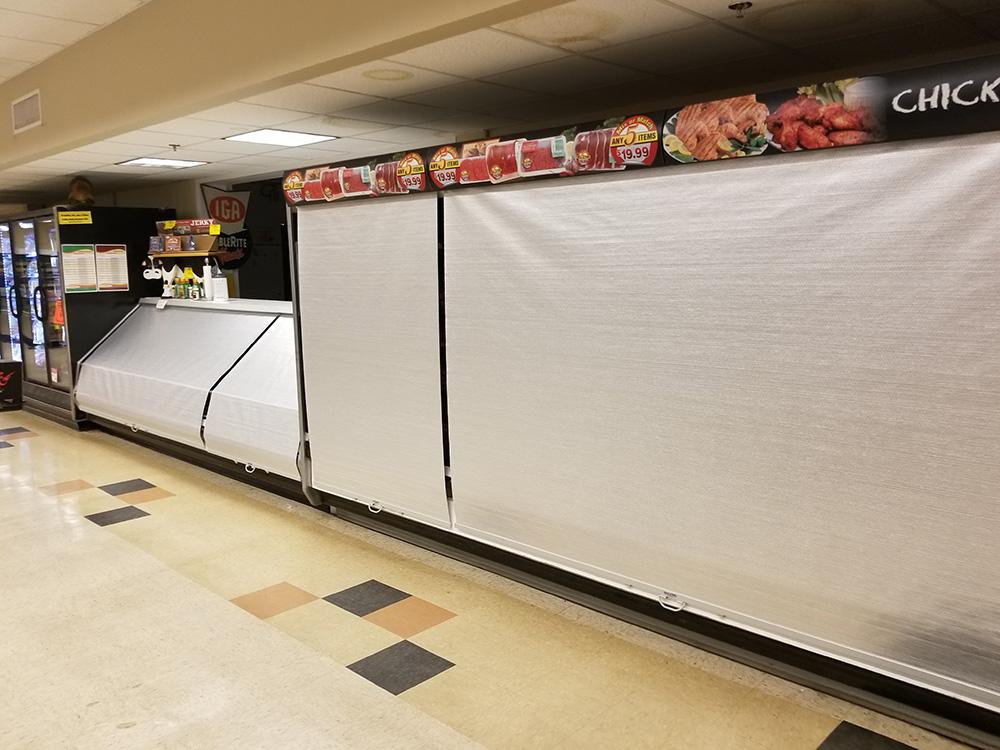
Night covers provide a static thermal barrier over open refrigerated cases during non-operational hours. Their benefits include:
- Capital Efficiency
- Econofrost night covers require a fraction of the capital investment of full case replacement or glass door retrofits.
- Covers can be customized for various case geometries, including multi-deck, island, or low-ceiling formats, without the need for structural modifications.
- Labour and Installation
- Deployment is simple and quick, integrated into nightly store routines.
- Installation disruption is minimal, preserving store operations during the day.
- Staff training ensures consistent deployment and proper handling to maintain cold-air retention and complement low-heat, food-safe LED lighting for meat display lighting, produce display lighting, bakery display lighting, deli display lighting, and seafood display lighting.
- Maintenance and Longevity
- Routine cleaning, inspection, and timely fabric replacement ensure long-term performance.
- Covers remain compatible with existing refrigeration systems and LED lighting, preserving visual merchandising standards and product safety.
- Operational Benefits
- Night covers reduce ambient air infiltration, stabilizing overnight case temperatures.
- They maintain cold-chain integrity across produce, meat, deli, bakery, and seafood departments.
- Reduced refrigeration load supports energy efficiency and contributes to sustainability initiatives.
Full Case Replacement: Capital-Intensive but Permanent
Replacing an open refrigerated case with a new unit may provide higher baseline efficiency but involves significant investment:
- Capital and Disruption
- Full case replacement entails substantial upfront capital and potential structural modifications.
- Installation requires downtime, which can disrupt store operations and merchandising.
- Staff must adjust to new case functionality, potentially retraining for deployment of any new systems or lighting adjustments.
- Labour and Maintenance
- While new cases may have advanced features, such as improved airflow or integrated low-heat, food-safe LED lighting for meat display lighting, produce display lighting, bakery display lighting, deli display lighting, and seafood display lighting, maintenance schedules must still be followed.
- Any future repairs or replacements of case components add to ongoing operational costs.
- Lifecycle Considerations
- Full replacement provides a long-term solution but can take years to achieve ROI, depending on energy savings and operational efficiencies.
- Unlike night covers, case replacement does not offer flexible seasonal adjustment or portability for multi-department use.
Glass Door Conversion: Balancing Energy Efficiency and Shopper Experience
Retrofitting open cases with glass doors is another common strategy to improve cold-air retention.
- Capital and Installation
- Glass door conversion represents a moderate-to-high capital investment, depending on the number of cases and door types.
- Installation can be disruptive, requiring temporary closures or restricted access to departments.
- Retrofit design must ensure compatibility with existing refrigeration systems and low-heat, food-safe LED lighting for meat display lighting, produce display lighting, bakery display lighting, deli display lighting, and seafood display lighting to maintain visual merchandising quality.
- Labour and Operations
- Staff may need training to open and close doors efficiently while stocking and maintaining displays.
- Doors introduce additional cleaning requirements and potential wear-and-tear on hinges and seals.
- Energy and Lifecycle
- Glass doors reduce overnight heat infiltration and energy consumption but limit immediate shopper access, which may affect impulse sales in high-turnover departments.
- Lifecycle benefits depend on door quality, seal integrity, and long-term maintenance.
Comparing Total Cost of Ownership (TCO)
When evaluating TCO, retailers should consider multiple factors:
- Capital Expenditure
- Night covers: Low-cost, easily customizable for multiple departments.
- Full case replacement: High capital investment with structural and installation considerations.
- Glass doors: Moderate-to-high capital investment with potential for retrofit complications.
- Labour and Operational Disruption
- Night covers: Minimal disruption; integrated into nightly routines.
- Full replacement: Significant downtime during installation and adjustment periods.
- Glass doors: Moderate disruption; requires staff adjustment and cleaning protocols.
- Maintenance Requirements
- Night covers: Cleaning, inspection, and periodic fabric replacement.
- Full replacement: Regular servicing, LED lighting checks, and potential component repair.
- Glass doors: Cleaning, hinge maintenance, and seal checks.
- Cold-Chain and Product Quality Impact
- Night covers: Provide overnight thermal protection, complementing low-heat, food-safe LED lighting for meat display lighting, produce display lighting, bakery display lighting, deli display lighting, and seafood display lighting.
- Full replacement: Improved baseline efficiency, but benefits depend on system design and usage.
- Glass doors: Reduces overnight infiltration but may limit customer access or merchandising flexibility.
- Lifecycle and Flexibility
- Night covers: Portable, adaptable to seasonal or multi-department use; quick ROI.
- Full replacement: Long-term investment with fixed configuration.
- Glass doors: Semi-permanent; less adaptable to seasonal or department-specific needs.
Conclusion
Econofrost night covers provide a low-capital, high-impact solution for maintaining cold-chain integrity, protecting fresh-food quality, and supporting operational efficiency. Compared with full case replacement or glass door conversion, night covers offer a favorable total cost of ownership due to minimal disruption, low installation costs, straightforward maintenance, and adaptable multi-department deployment. By integrating covers with low-heat, food-safe LED lighting for meat display lighting, produce display lighting, bakery display lighting, deli display lighting, and seafood display lighting, retailers can ensure product visibility and freshness while reducing energy consumption, waste, and labor. Understanding TCO across capital, labour, maintenance, and lifecycle factors enables store operators to make informed decisions that align with operational goals, sustainability initiatives, and shopper expectations.
CTA
To explore Econofrost night covers and evaluate total cost of ownership for your fresh-food displays, visit:
https://www.econofrost.com
[/fsn_text][/fsn_column][/fsn_row]